

We’re excited to announce a recent team paper, based on work in our lab about both personality development and identity development among young adults. This paper, titled “Relations of Personality Traits, Character, and Narrative Identity with Emerging Adults’ Identity Statuses” is in press at the Journal for Adult Development and was led by Dr. Booker and included grad student Chloe Johnson and former undergraduate research assistants Sienna Chavez and Lauren Wyatt as co-authors.
This manuscript focuses on how a group of college adults reported on three different form of personality development, and how these different measures of personality could be important for identity development.
- Personality traits, like the Big Five, involve broad ways of interacting with the world that are argued to be less “conditional” on situations and contexts. For example, people who are better organized (high in conscientiousness) should show behaviors for being better organized at home, with friends, and at work. Traits are apparent from earlier in childhood.
- Characteristic adaptations, like tendencies to experience hope, gratitude, and forgiveness, involve the ways people are broadly motivated to behave out in the world, but could be adjusted more often depending on contexts and surrounding relationships. The form of personality emerges across childhood, following the earlier traits.
- Narrative identity, like the ways people go about organizing a complex, stable life story is also important for daily functioning. This form of personality takes longer to fully develop, but is apparent by puberty and the teen years.
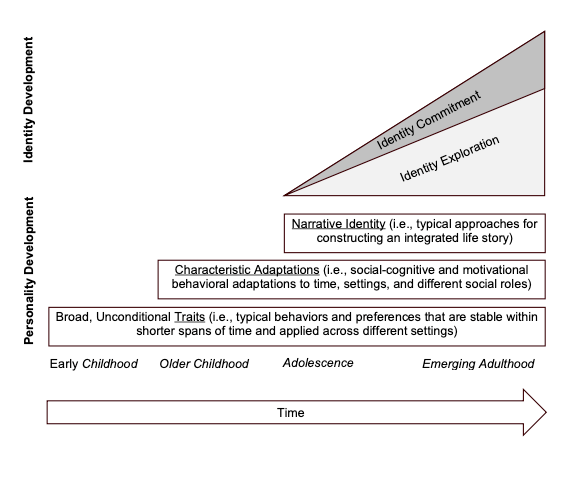
- Identity involves a complex, integrated, and (relatively) stable construction of one’s sense of self. This is an understanding of oneself that persists over time and involves self-knowledge, values, and personal goals.
- To form an identity is one of the major developmental tasks that begins in the teen years and continues into adulthood.
- Researchers often study different “statuses” of identity, depending on the ways people are exploring possibilities for their identity (ex. college students trying different majors or different extracurricular clubs) and are committing to aspects of their identity (ex. deciding on a career direction; deciding how to approach romantic relationships).
We tested how multiple measures of personality traits, character, and narrative identity would be related to identity statuses among college adults. We were interested in how personality was related to identity achievement, and evidence that people had both explored different options and committed to forms of identity that made the most sense for them.
Multiple personality measures were related to identity achievement. For example, people with achievement reported being more extraverted, open to new experiences, hopeful, persistent, and in control of life events. Three personality measures of trait neuroticism, hoepfulness, and narrated agency were strongly and uniquely related to identity measures when all of our personality measures were tested at the same time.
This was a helpful study to reinforce that there are appreciable differences between different aspects of personality and that multiple measures of personality can bring important information to the big developmental task of exploring and embracing one’s identity.
References and Additional Readings
Booker, J. A., Johnson, C. L., Chavez, S., & Wyatt, L. (2025). Personality and identity among emerging adults: How do three levels of personality inform identity development? Journal of Adult Development. Advance online publication.
Booker, J. A., Wesley, R., & Pierre, N. (2021). Agency, identity development, and subjective well-being, among undergraduate students at a central US university. Journal of College Student Development, 62(4), 488–493. https://doi.org/10.1353/csd.2021.0049
McAdams, D. P., & Pals, J. L. (2006). A new Big Five: Fundamental principles for an integrative science of personality. American Psychologist, 61, 204–217. doi: 10.1037/0003-066X.61.3.204
 The Milestones Lab at Mizzou